
Hydrogen’s Blind Spot: The Plastics Footprint in Clean-Energy Operations—and a Practical Path to Decarbonize It
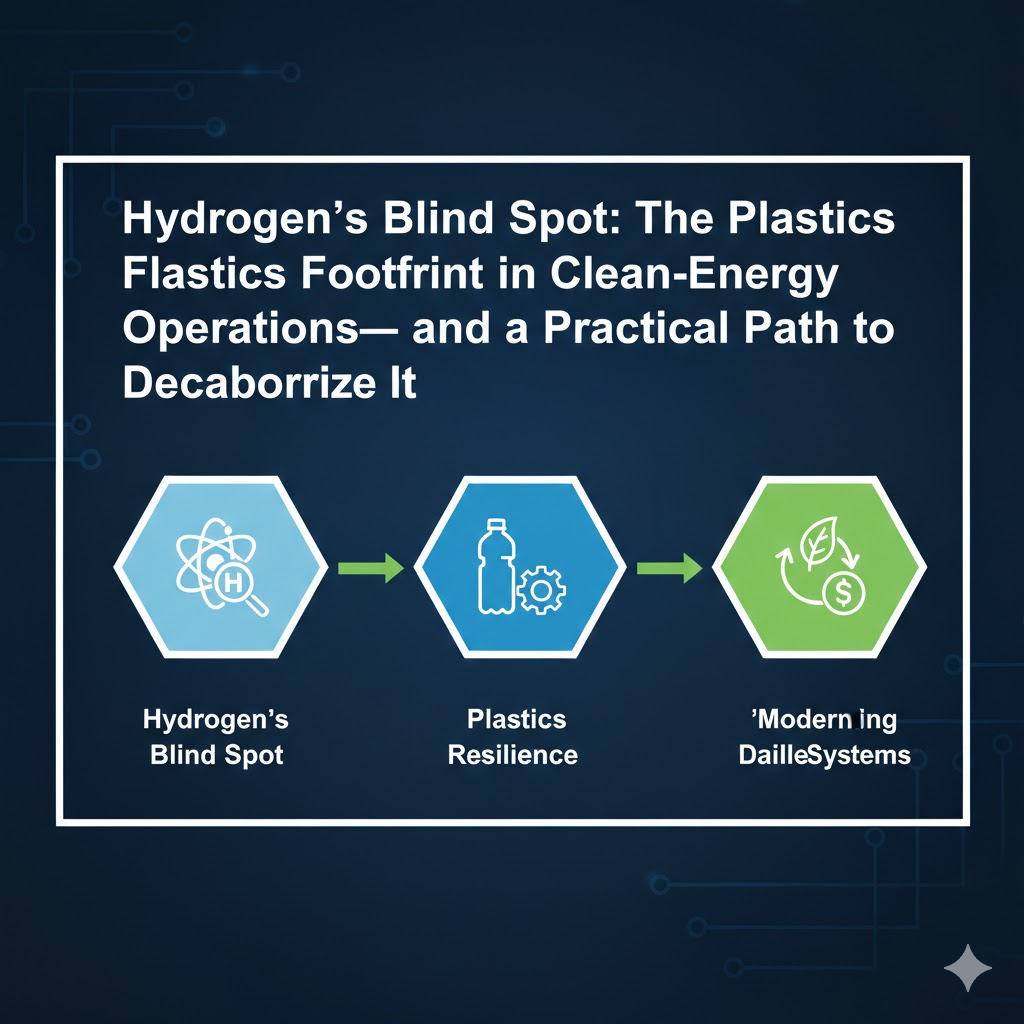
Hydrogen executives are rightly focused on electrolyzer efficiency, renewable PPAs, storage integrity, and offtake certainty. Yet across the hydrogen value chain—construction sites, commissioning teams, control-room shifts, mobile maintenance crews, conference activations, and industrial canteens—there’s a quieter emissions stream that rarely makes it into project dashboards: single-use packaging and serviceware.
This matters for two reasons. First, plastics are not “small” in climate terms when scaled across multi-year build-outs and high-throughput operations. Upstream fossil feedstocks, process heat, and end-of-life handling create a measurable carbon and risk footprint. Second, hydrogen projects are increasingly evaluated on system decarbonization, not just the molecules produced. As ESG reporting tightens and buyers scrutinize Scope 3, avoidable plastics become the kind of operational leakage that undermines net-zero credibility.
A more modern approach is emerging: treat packaging as an engineered procurement category—similar to valves, gaskets, or PPE—defined by performance specs, end-of-life pathways, and verified material chemistry. Manufacturers like Bioleader support this “execution layer,” supplying compostable foodservice packaging designed for industrial use cases where performance and compliance matter.
Hydrogen operations, however, should not “swap everything” overnight. The winning approach is to segment use cases, standardize SKUs, and align materials with local end-of-life infrastructure. A practical starting point is cold-beverage service, where disposal streams are easier to govern and user expectations are straightforward—especially when teams adopt clear compostable PLA cold cups built for industrial beverage service as a standardized consumable for canteens, hydration stations, and visitor days.
Why Plastics Show Up on the Hydrogen Ledger (Even When You Don’t Track Them)
Hydrogen developments concentrate people, logistics, and consumables. The packaging footprint typically spikes in five hotspots:
- EPC and commissioning periods: large, rotating teams eat on-site; takeout packaging becomes the default.
- Remote operations: offshore, desert, or industrial corridors rely on centralized catering and packaged meals.
- HSE-driven single-use policies: shift work and hygiene protocols often prefer disposable formats.
- Events and stakeholder engagement: site visits, supplier days, and trade shows drive high-volume beverage cups.
- Maintenance windows: shutdowns and turnarounds increase meals-to-go and drink service.
In most organizations, packaging is purchased as a commodity. That procurement posture creates three systemic failures:
- No material governance (unknown additives, barrier chemistries, or regulatory exposure).
- No end-of-life alignment (compostables sent to landfill; recyclables contaminated by food).
- No lifecycle accountability (Scope 3 not measured, therefore not managed).
For hydrogen businesses competing on “clean,” these failures are increasingly visible. The business case for change is less about marketing and more about operational risk control: avoiding non-compliant materials, reducing waste handling complexity, and meeting buyer expectations in industrial tenders.
The Engineering Standard for Low-Carbon Packaging in Industrial Settings
Hydrogen projects don’t need “green vibes.” They need packaging that performs under heat, moisture, and time constraints while fitting real disposal systems. A practical engineering standard includes four decision gates:
1) Functional performance under real operating conditions
- Thermal stability (hot beverages, hot foods, short holding times)
- Moisture and oil resistance (condensation, sauces, high-fat meals)
- Structural rigidity (stacking, transport, forklift handling in bulk cartons)
2) Material chemistry that aligns with compliance trends
Industrial buyers are increasingly cautious about persistent chemicals in food-contact materials and coatings. Packaging programs should specify:
- Food-contact compliance documentation
- Clear statements on barrier technology
- Test reports where applicable (migration, heat, overall safety)
3) End-of-life path that matches local infrastructure
Compostable materials deliver value only when the downstream pathway exists (industrial composting, organics collection, or specialized handling). Otherwise, the decision should prioritize waste prevention and contamination control over theoretical compostability.
4) Procurement economics that scale
Hydrogen operations are cost-managed environments. The best programs:
- Standardize SKUs across sites
- Reduce packaging variety (fewer bins, fewer training steps)
- Buy in consolidated volumes with consistent specs
PLA Cups and the Cold-Drink Reality: Where They Fit, Where They Don’t
PLA (polylactic acid) is a bio-based polymer commonly used for cold beverage cups. In hydrogen-adjacent operations, cold drinks dominate more than many teams expect—water, electrolyte beverages, iced coffee, and chilled soft drinks in warm environments or during active field work.
Where PLA cups make sense operationally
- Cold beverage service with controlled collection (on-site cafés, canteens, or event zones where bins are managed)
- High-volume hydration stations (standardized cup size and lid formats reduce procurement complexity)
- Visitor and stakeholder events (predictable demand, predictable waste stream, improved optics without performance compromise)
Where PLA cups can fail if misapplied
- Hot beverage exposure: heat can deform PLA and compromise user experience and safety
- No organics stream: if everything goes to landfill, you lose much of the intended environmental benefit
- Contamination-heavy environments: mixed waste bins and food contamination can derail both recycling and composting
The executive takeaway is simple: PLA is a tool, not a blanket solution. Use it where cold-use dominates and where disposal can be governed. For hot drinks and high-heat applications, other paper-based or fiber-based solutions may be more appropriate.
Quantifying the Impact: Why This Is Not Just “Small Stuff”
Even when packaging looks minor at a single site, scale does the damage. Hydrogen hubs run multi-year build schedules with high headcounts, and operational sites run daily consumables at predictable volumes. Over time, packaging becomes a measurable contributor to upstream emissions (feedstock extraction and polymer production), waste management cost and risk (sorting, hauling, contamination), and reputational exposure (visible waste contradicting “clean energy” messaging).
More importantly, packaging is one of the few categories where change can be implemented quickly. You don’t need new permits, grid upgrades, or electrolyzer redesigns. You need a spec, a supplier, a training card, and a bin strategy.
A Deployment Playbook for Hydrogen Sites
A high-performing packaging transition looks like an operations program—not a sustainability campaign.
Step 1: Segment use cases (don’t start with “replace everything”)
Break demand into cold drinks, hot drinks, hot meals/oily foods, and condiment/accessory items.
Step 2: Standardize SKUs across sites
Standardization reduces supplier variability, training complexity, storage footprint, and waste-stream confusion.
Step 3: Build a disposal map before you buy at scale
Identify organics collection, composting acceptance criteria, and contamination rules. If no composting exists, design for waste minimization and clean separation.
Step 4: Write procurement specs like an industrial category
Include temperature range, leak resistance, rigidity targets, palletization requirements, and documentation standards.
Step 5: Pilot, measure, then scale
Measure unit cost vs baseline, waste volume and contamination rate, user complaints (leaks, lid fit, deformation), and handling time.
Strategic Conclusion: Packaging Signals System Integrity
Hydrogen leadership is moving from proof-of-concept to industrialization. In that shift, credibility is built through execution discipline: every avoidable emission source and compliance risk becomes a strategic liability.
Single-use packaging is not the largest carbon lever in hydrogen—but it is one of the easiest to professionalize quickly. The organizations that win will treat it as part of operational excellence: engineered material choices, end-of-life alignment, standardized procurement, and measurable performance.
Done correctly, it reduces waste risk, strengthens ESG reporting, and signals that your “clean” claim is supported by the full operational system—not just the electrolyzer stack.
